I recently purchased a laptop (Compaq Presario B1803) and a Mobiblu 1GB MP3 player. The laptop has since become quite indispensable (especially for doing assignments related to the post graduate courses). The MP3 player is also unique because of its cube-like shape and its size. Both were purchased from India. While I paid close to Rs. 75K for the laptop, I had to shell out about Rs. 7K for the MP3 player.
Another of the recent buys was an apartment in a building that is under construction in the far-flung suburbs of Mumbai (actually, in Airoli in Navi Mumbai). This is supposed to be ready for occupation sometime in March 2007.
Over the weekend, I was at Dadar (West) hunting for some "Abhang" books for a co-worker of mine. (The co-worker has initiated a "weekly prayer meeting" every Thrusday and needed some copies of the Abhang book to be able for the people to sing from the book.). I was quite disappointed at the fact that I wasn't able to find the book that I had bought a few months back from Titwala. That disappointment was even more due to the fact that the book publishers were from Parel, just some distance away from Dadar.
Until some years ago, Dadar was "the" market place where one could get most of such "Maharashtrian" things. There is still the same kind of feeling one gets these days, but its much reduced. One of the comments in the caustic monologue in "Mee anu Maza Shatrupaksh" (me and my enemies) by P. L. Deshpande (a.k.a. Pu La) was (to translate to English): "On Ranade Road in Dadar, Mumbai and Laxmi Road, Pune there is nothing that one cannot get that is available in the other parts of the world". Although this was a bit of an exaggeration (it was more of humor), one could still imagine the market place that was Dadar.
Sunday, March 26, 2006


Sunday, March 19, 2006
The mysterious RVJ
This one must stump the staunchest Mumbaikars or other people who know Mumbai well. Where is the station whose code is RVJ? Or have you heard of a station called "Raoli Junction"?
The closest that I'd heard is a place called "Raoli" (which is supposed to be some place near Antop Hill and GTB Nagar). Now, the thing is that all signal posts in an around VDLR (Wadala Road) are controlled through this RVJ. Maybe it is some station on the private Mumbai port trust railway line. Maybe...maybe not.
The closest that I'd heard is a place called "Raoli" (which is supposed to be some place near Antop Hill and GTB Nagar). Now, the thing is that all signal posts in an around VDLR (Wadala Road) are controlled through this RVJ. Maybe it is some station on the private Mumbai port trust railway line. Maybe...maybe not.
A day in court
If you ever wondered how the proceedings went on in a "real" court, take a look at this real-life incident on rediff. Dilip D'Souza goes on to describe how he was a witness to an accident and a day in the court being a witness.
The part where he is asked to memorize things by the lawyer seems quite funny and indicates how these legal things work. You have to be sure about all the details even though it was about 5 years after the actual accident that he was attending the court.
The part where he is asked to memorize things by the lawyer seems quite funny and indicates how these legal things work. You have to be sure about all the details even though it was about 5 years after the actual accident that he was attending the court.
Back from Paris
After a series of Bon jour and Merci, I finally reached India just after the 0 hour on Saturday morning. It could've been one of the flawless and no nonsensical trips had it not been for a silly error on the part of the person booking the ticket. Some guy had me booked for the 12th of April, instead of the 17th of March.
I had reserved the 16th evening for some sight seeing and shopping (things for others). Instead, when I took a look at the ticket (for seeking confirmation from the airline), I realised that it was for the 12th of April. These e-tickets can be so damn confusing what with no alignment in the columns of data. (There were 3 dates for the same flight: 17th March, 12th April and 14th April. The "real" flight date was 12th April). As a result of the panic-inducing-like situation, I had to spend time trying to call up people and try to hunt on the Internet for a clue as to when the "real" booking was.
I had a class on Saturday afternoon and Eiffel was no major reason to miss it. That was the reason why I wanted to take the flight on Friday itself. The end result was that it was so late that we just ended up going to an Indian restaurant called "Palais De Vandan". No Eiffel, no Mona Lisa, no museums, no other sight seeing.
I had to get up at 3 a.m. in the wee hours of Friday morning to get across the call to get our guys to change the date. That's how the trip went. Maybe next time there is enough time.
On the other hand, I had breakfast on most mornings at the "Maison Internationale" restaurant (a variety of croissants, cafe au lait and orange jus). Dinner on all 3 nights were eaten out - 2 at Indian restaurants and 1 at Pizza Hut. Lunch on all 3 days was at the workplace - and it was with a lot of variety (including something for the veggies).
Since there was no hotel accomodation available near the workplace, I had to put up at the Maison de l'Inde. That is some sort of a hostel for Indian students at the "Cite Universitaire". Looking back, it was quite an okay place (for the price).
I had reserved the 16th evening for some sight seeing and shopping (things for others). Instead, when I took a look at the ticket (for seeking confirmation from the airline), I realised that it was for the 12th of April. These e-tickets can be so damn confusing what with no alignment in the columns of data. (There were 3 dates for the same flight: 17th March, 12th April and 14th April. The "real" flight date was 12th April). As a result of the panic-inducing-like situation, I had to spend time trying to call up people and try to hunt on the Internet for a clue as to when the "real" booking was.
I had a class on Saturday afternoon and Eiffel was no major reason to miss it. That was the reason why I wanted to take the flight on Friday itself. The end result was that it was so late that we just ended up going to an Indian restaurant called "Palais De Vandan". No Eiffel, no Mona Lisa, no museums, no other sight seeing.
I had to get up at 3 a.m. in the wee hours of Friday morning to get across the call to get our guys to change the date. That's how the trip went. Maybe next time there is enough time.
On the other hand, I had breakfast on most mornings at the "Maison Internationale" restaurant (a variety of croissants, cafe au lait and orange jus). Dinner on all 3 nights were eaten out - 2 at Indian restaurants and 1 at Pizza Hut. Lunch on all 3 days was at the workplace - and it was with a lot of variety (including something for the veggies).
Since there was no hotel accomodation available near the workplace, I had to put up at the Maison de l'Inde. That is some sort of a hostel for Indian students at the "Cite Universitaire". Looking back, it was quite an okay place (for the price).
Wednesday, March 15, 2006
3 nigths in Paris
Starting from yesterday, I'll be spending 3 nights in Paris (on a "business" trip). So, this post is from Paris. Because of unavailability of rooms in hotels close to the workplace, I am staying in a hostel ("Cite Universitaire"). The hostel has Wi-Fi in the campus...so this post is over the Wi-Fi.
I travel by the RER Line B (which is like a "local train") to some place and then take a bus to commute to the workplace.
I travel by the RER Line B (which is like a "local train") to some place and then take a bus to commute to the workplace.
Sunday, March 05, 2006
M.S.D.
No, not Mahendra Singh Dhoni and nor is it a new hallucination drug like Lysergic acid Diethylamide (LSD).
MuthuSwamy Dikshitar, one of the trinity of the Carnatic composers (along with Thyagaraja and Shyama Sastry), was one of the most brilliant composers (music as well as lyrics). One of his most famous and widely-rendered composition is the famous "Vaathapi Ganapatim".
MuthuSwamy Dikshitar, one of the trinity of the Carnatic composers (along with Thyagaraja and Shyama Sastry), was one of the most brilliant composers (music as well as lyrics). One of his most famous and widely-rendered composition is the famous "Vaathapi Ganapatim".
Sunday, February 26, 2006
Rationing the electricity usage
Come summer, the "load" (demand) on the electricity usage in the city of Mumbai increases greatly. Over the years (due to the increasing urban population and maybe due to the lack of setting up of newer power generation plants), the demand outstripped supply completely. Multiple areas (mostly suburbs and Thane district) have to bear the brunt of the "load shedding". In some places, there is no power supply for more than 8 hours.
While Mumbai was largely unaffected, it might not get spared this year. As mentioned in this article, the MERC is deciding to "ration" the electricity usage. Anyone who uses more than 300 units in a month has to pay a heavy fine. Now that makes a bit of sense...in the short term, its a very good solution. Unless, people realise the situation, they are going to "use" electricity like anything. The BEST that supplies electicity to the southern parts of the city plans to implement the above scheme. It is fairly obvious that its meant to curb the usage of air-conditoners. In some homes as mentioned in this article, there are upto 3 air-conditoners installed. An air-condtioner is known to consume in 40 minutes as much power as a ceiling fan can in 24 hours.
It remains to be seen whether the fine will actually be implemented and if it is, then how effective it would be. Mumbai has got a fairly large population of people who can pay any amount (fine or no fine) for whatever they want. But, it might make some upper middle-class people sit up and take notice and work out ways to "save" electricity.
I feel this is a good short-term measure. Also, it should give a boost for research into alternative sources of energy. For example, hand wound mobile phone chargers as well as solar-powered phone chargers have made an appearance in foreign markets. However, they are a bit expensive and the hand-wound ones need a lot of winding to be useful on a daily basis. Maybe if we could reduce the cost and improve the performance of these, it would help save some electricity.
This article claims that a certain 7-storeyed "bungalow" in Juhu has been running on hybrid power (solar and wind) to reduce its dependency on the electric supply. Interestingly, the article mentions that this was the only bungalow that had power during the 26th July deluge.
Time for the appropriate engineers and scientists to start thinking and developing these things at an affordable price so that its usage becomes more common place. Instead of spending time worrying about some stupid payroll application, maybe they could concentrate in their own fields for a while and help India out of a difficult crisis.
While Mumbai was largely unaffected, it might not get spared this year. As mentioned in this article, the MERC is deciding to "ration" the electricity usage. Anyone who uses more than 300 units in a month has to pay a heavy fine. Now that makes a bit of sense...in the short term, its a very good solution. Unless, people realise the situation, they are going to "use" electricity like anything. The BEST that supplies electicity to the southern parts of the city plans to implement the above scheme. It is fairly obvious that its meant to curb the usage of air-conditoners. In some homes as mentioned in this article, there are upto 3 air-conditoners installed. An air-condtioner is known to consume in 40 minutes as much power as a ceiling fan can in 24 hours.
It remains to be seen whether the fine will actually be implemented and if it is, then how effective it would be. Mumbai has got a fairly large population of people who can pay any amount (fine or no fine) for whatever they want. But, it might make some upper middle-class people sit up and take notice and work out ways to "save" electricity.
I feel this is a good short-term measure. Also, it should give a boost for research into alternative sources of energy. For example, hand wound mobile phone chargers as well as solar-powered phone chargers have made an appearance in foreign markets. However, they are a bit expensive and the hand-wound ones need a lot of winding to be useful on a daily basis. Maybe if we could reduce the cost and improve the performance of these, it would help save some electricity.
This article claims that a certain 7-storeyed "bungalow" in Juhu has been running on hybrid power (solar and wind) to reduce its dependency on the electric supply. Interestingly, the article mentions that this was the only bungalow that had power during the 26th July deluge.
Time for the appropriate engineers and scientists to start thinking and developing these things at an affordable price so that its usage becomes more common place. Instead of spending time worrying about some stupid payroll application, maybe they could concentrate in their own fields for a while and help India out of a difficult crisis.
Sunday, February 12, 2006
H. A. J. C.
HAJC is "Haji Ali Juice Centre". Ever since I recollect, I've seen this small shop just outside the way to the Haji Ali dargah. It specializes in fruit juices and milkshakes. It is run by Malayalee muslims (the same guys who also run the Cafe Noorani across the road). Though it may have begun as a "Juice Centre", it also serves some popular "fast food" snacks such as pizzas (grated cheese on top), sandwiches and burgers.
The place is fairly small and has about 8 very small tables. Most people prefer to stand outside and eat or drink. The place is almost always packed to capacity in the evenings where the people who come to visit the dargah and / or the Mahalaxmi temple drop in to have a snack and / or to quench their thirst.
The juices range from Rs. 20 (for plain lemon juice) to about Rs. 400 (for the imported pomegranate aka "Kabuli Anar").
Apart from the juices, the stall also has milkshakes and "fruit cream" (diced fruits in cream). The guy also gets orders from the "Gelf" and the "middil yeast". All items are also available as "parcel". The packing of this "fruit cream" is done very meticulously in thermocol boxes with dry ice to keep the thing cool.
I have seen the traffic police at the Haji Ali circle have tea at this stall, so I guess they might be making tea too.
It is supposed to be open until late hours in the night...maybe the shop "takes good care" of the cops.
The place is fairly small and has about 8 very small tables. Most people prefer to stand outside and eat or drink. The place is almost always packed to capacity in the evenings where the people who come to visit the dargah and / or the Mahalaxmi temple drop in to have a snack and / or to quench their thirst.
The juices range from Rs. 20 (for plain lemon juice) to about Rs. 400 (for the imported pomegranate aka "Kabuli Anar").
Apart from the juices, the stall also has milkshakes and "fruit cream" (diced fruits in cream). The guy also gets orders from the "Gelf" and the "middil yeast". All items are also available as "parcel". The packing of this "fruit cream" is done very meticulously in thermocol boxes with dry ice to keep the thing cool.
I have seen the traffic police at the Haji Ali circle have tea at this stall, so I guess they might be making tea too.
It is supposed to be open until late hours in the night...maybe the shop "takes good care" of the cops.
The Great GATE Grate
GATE 2006 was a nightmare for me. I had decided to take the exam again (after GATE 2005) in a bid to improve my score. Since the GATE scores are valid for a period of 2 years, the GATE 2005 score is still valid, but I thought I would try my luck again.
The prepraration to the exam was much below expectations (since I was busy with office work even on days that I had taken "leave" on). The exam itself was held today (12th Feb 2006) from 09:30 to 12:30. And, my performance is much below what I might have expected to be. However, not all is lost. GATE is a relative performance exam - it all depends on how poorly others fare. So, there is still hope.
Results will be out in a month...and if you do not hear about it on this site, you know that others have fared better.
The prepraration to the exam was much below expectations (since I was busy with office work even on days that I had taken "leave" on). The exam itself was held today (12th Feb 2006) from 09:30 to 12:30. And, my performance is much below what I might have expected to be. However, not all is lost. GATE is a relative performance exam - it all depends on how poorly others fare. So, there is still hope.
Results will be out in a month...and if you do not hear about it on this site, you know that others have fared better.
W/L
One of the favorite lines we often come across in English stories is this "The quiet of the valley was broken by the sharp toot of the train passing by". Most previous visits to Lonavala I could understand what the authors meant.
If one has ever stayed in Lonavala, one can hear numerous trains blowing their horns as they pass by. With small hillocks on either side of the tracks, the sound of the horn echoes throughout Lonavala and is clearly audible even in the day time (even across the busy highways).
 On the last visit, the reason for this got cleared up. It so happened that a few of us (co-workers) had to stay in Lonavala to attend some sort of training programme. Since one of them was quite enthusiastic about morning walks, I would go along with the guy (it was rainy season and we had to wear some jacket to cover ourselves). On one of the days we wandered off and on our way back happened to cross the railway tracks. Right in front, there stood the board with the bold letters "W/L". Anyone (connected with the railways) knows what that means. "W/L" is an instruction to the loco pilot (drivers are called pilots in Indian Railway terminology) to "Whistle / Level crossing ahead".
That was the reason for all the trains going through Lonavala blowing their horns like mad. Since there is also a "blind curve" that leads into the railway level crossing, it is all the more important for the pilot to blow their horns. (Its a bit like the blind curve that leads into Grant Road station on the suburban local lines in Mumbai - one of the reason of multitudes of people being run over by trains near Grant Road).
This "W/L" also comes in a Hindi variant. It is pronounced "See / Pha" and is written in the Devnagiri script ("Seethi Bajao / Phatak aa raha hai").
If one has ever stayed in Lonavala, one can hear numerous trains blowing their horns as they pass by. With small hillocks on either side of the tracks, the sound of the horn echoes throughout Lonavala and is clearly audible even in the day time (even across the busy highways).

That was the reason for all the trains going through Lonavala blowing their horns like mad. Since there is also a "blind curve" that leads into the railway level crossing, it is all the more important for the pilot to blow their horns. (Its a bit like the blind curve that leads into Grant Road station on the suburban local lines in Mumbai - one of the reason of multitudes of people being run over by trains near Grant Road).
This "W/L" also comes in a Hindi variant. It is pronounced "See / Pha" and is written in the Devnagiri script ("Seethi Bajao / Phatak aa raha hai").
Sunday, January 29, 2006
RIP : Supriya
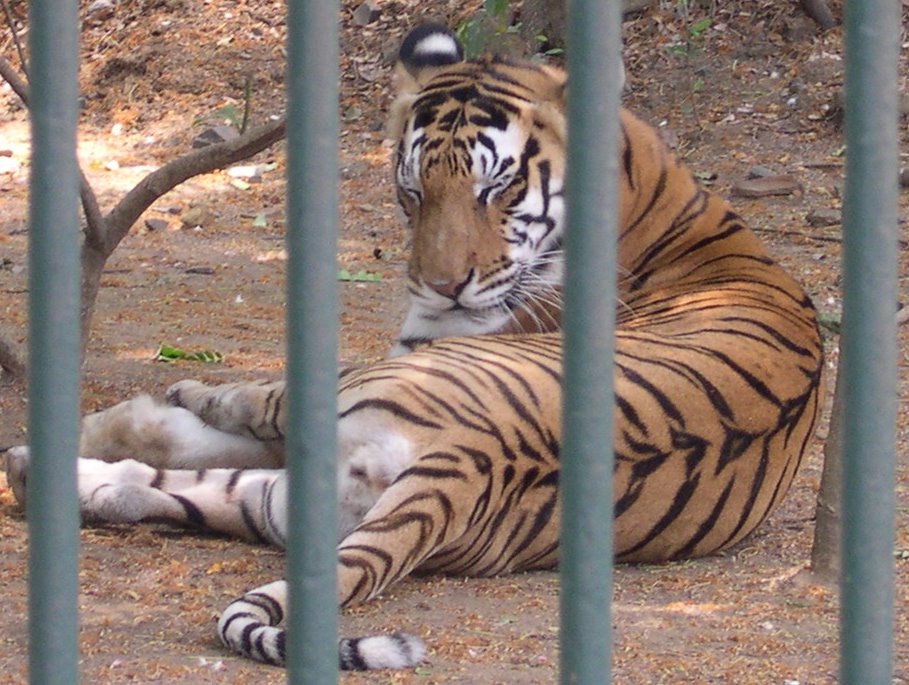
Although a bit late, this one is in memory of Supriya, the only tigress of the Byculla zoo that died end of December 2005. As can be seen from the reports (and here), she died of kidney failure.
As far as I could see during my visits to the zoo, she was very popular among all age groups of visitors. Indeed, she was aptly named "Supriya" (meaning the most beloved). She had a fairly large enclosure by Byculla-zoo standards and the enclosure had a couple of "small caves" and a water pond where she would laze about in the hot summer months.
Here is a photograph of Supriya that I had shot sometime in April 2005. Now only if I had that SLR instead of the stupid compact digital camera...
Vesave Koli Food Festival 2006
As part of the Mumbai Festival 2006, several events were held in various parts of the city. One among them was the "Vesave Koli Food Festival" at Versova. This "sub-festival" was held on January 20th to January 22nd. I decided to visit it on the last day. The timings were 6 p.m. to 9 p.m.
Being a Sunday, I expected some crowd, but as the time passed by, the crowd only increased multi-fold much beyond my expectations. I reached the Versova bus stop at about 6:45 p.m. and decided to walk the rest of the way. It took me some time (and the guidance of a native co-worker, whom I happened to meet by chance in the "village") to find the way to the actual place.
Versova (or Vesave as it is called by the natives) was a "real village" till some time ago. As time progressed by, the local fisherfolk have lost quite a bit of their business because of various reasons. Lack of carrying on the tradition by the new generation is also one of them. (I guess the reasoning is as follows: why would someone sweat it out on the rough seas, when one could be comfortable in a call-center office? Heh?). One could now see three to four-storeyed buildings where small houses once stood. Proliferation of other communities (noticably from the North of India) could also be seen.
But, the seniors are still around. One can see them wearing their tradtional attire (a lungi that forms a triangle near the ankles). Their skin tanned from the hot and UV-filled rays of the sun and those reflected off the water. These seniors, I guess, still go in to get the "catch". Typically, it is a night duty, since that is the time when the catch is more. These boats typically come in ashore at 5 a.m. or so.
Coming back to the festival, the Kolis (as the local fisherfolk are called), must have had it quite good. They were all smiles and why not. Looking at the crowd eating up everything they had to offer, they must've made quite a much-deserved fortune.
Being a Sunday, I expected some crowd, but as the time passed by, the crowd only increased multi-fold much beyond my expectations. I reached the Versova bus stop at about 6:45 p.m. and decided to walk the rest of the way. It took me some time (and the guidance of a native co-worker, whom I happened to meet by chance in the "village") to find the way to the actual place.
| Several stalls were put up where the local fishermen could cook and display their food items. (See the local church in the background. A temple was also present on the grounds, but I could not photograph it.) | 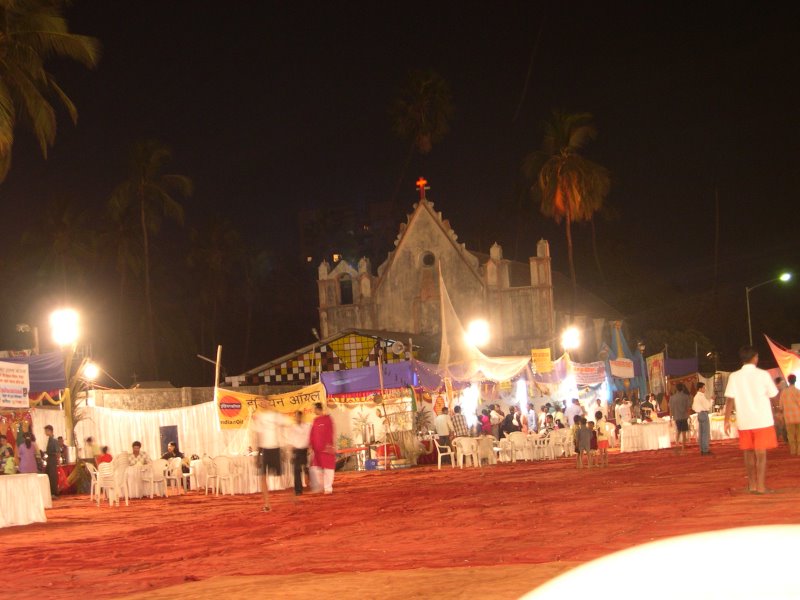 |
| The decoration was quite interesting with real boats, fish, nets and oars thrown in. | 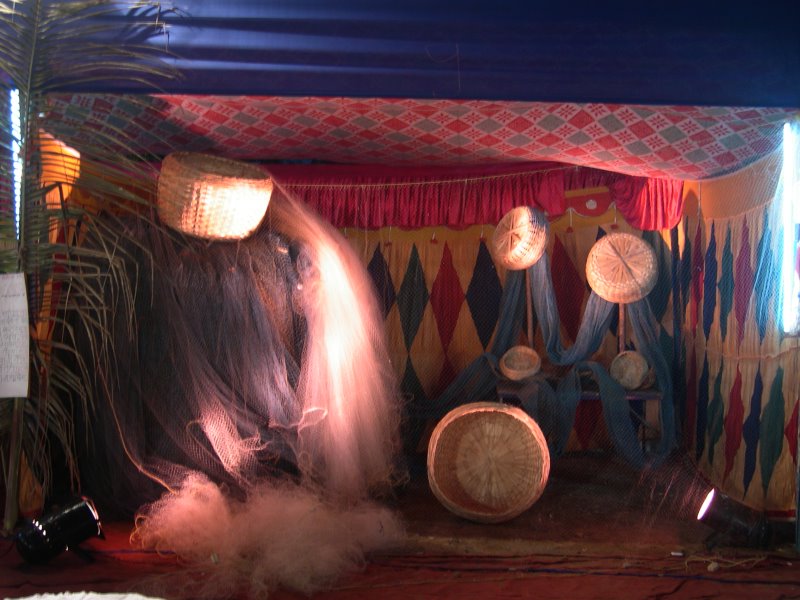 | 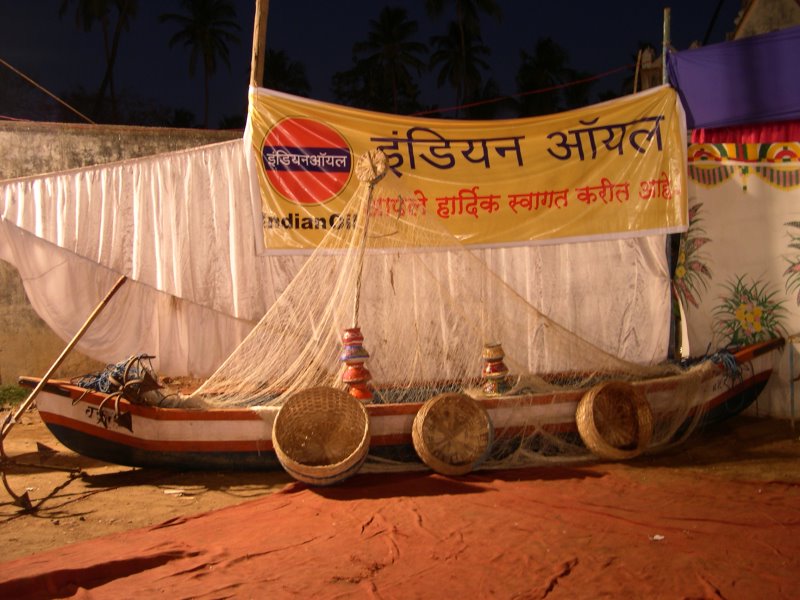 |
| A stage had been decorated where dance performances by the local fisherfolk were to be held. |  |
Versova (or Vesave as it is called by the natives) was a "real village" till some time ago. As time progressed by, the local fisherfolk have lost quite a bit of their business because of various reasons. Lack of carrying on the tradition by the new generation is also one of them. (I guess the reasoning is as follows: why would someone sweat it out on the rough seas, when one could be comfortable in a call-center office? Heh?). One could now see three to four-storeyed buildings where small houses once stood. Proliferation of other communities (noticably from the North of India) could also be seen.
But, the seniors are still around. One can see them wearing their tradtional attire (a lungi that forms a triangle near the ankles). Their skin tanned from the hot and UV-filled rays of the sun and those reflected off the water. These seniors, I guess, still go in to get the "catch". Typically, it is a night duty, since that is the time when the catch is more. These boats typically come in ashore at 5 a.m. or so.
Coming back to the festival, the Kolis (as the local fisherfolk are called), must have had it quite good. They were all smiles and why not. Looking at the crowd eating up everything they had to offer, they must've made quite a much-deserved fortune.
Sunday, January 22, 2006
Dr. Amar Bose @ Techfest
This year's Techfest at IITB featured a lecture series that included (among other luminaries) a lecture by Dr. Amar Bose. The lecture was held on Saturday 21st January at 08:00 a.m. Indian time.
Since I was keen to attend this lecture, I had to rush to attend the lecture. Nevertheless, I reached 10 minutes ahead of 08:00 a.m. and took my seat. It was only then that I realized that the lecture was not a "live" one, but a kind of "video conference" with Bose being seated in the U.S.A.
The lecture began on schedule and except for a discontinuation ("line drop") after half-an-hour into the lecture, it proceeded quite smoothly and went on for about 1hr and 45 minutes.
Dr. Bose began with a question to the co-ordinator (on the IITB side) as to what he must talk about. Finally, after asking about the composition of the audience, he said he would speak first about education (since the audience mostly comprised off under grad and post grad students).
Some key points from the lecture:
Since I was keen to attend this lecture, I had to rush to attend the lecture. Nevertheless, I reached 10 minutes ahead of 08:00 a.m. and took my seat. It was only then that I realized that the lecture was not a "live" one, but a kind of "video conference" with Bose being seated in the U.S.A.
The lecture began on schedule and except for a discontinuation ("line drop") after half-an-hour into the lecture, it proceeded quite smoothly and went on for about 1hr and 45 minutes.
Dr. Bose began with a question to the co-ordinator (on the IITB side) as to what he must talk about. Finally, after asking about the composition of the audience, he said he would speak first about education (since the audience mostly comprised off under grad and post grad students).
Some key points from the lecture:
- Dr. Bose was primarily a professor and mathematics seemed to be his core, but he got interested into acoustics because of a shoddy music system that he had obtained.
- He stressed that quality education was very important. Also important is the way in which education is being imparted.
- He pointed out that some of his research took place over a span of 25 years. In response to a question as to whether such long-term research made sense in today's past-paced world, he said that such research woud not be possible in a public company (because of the pressure of the stake holders). This was one reason for making Bose Corporation a private company.
- One of the reasons why he formed a separate company instead of continuing research at MIT, where he claimed to have a lot of freedom, was because of the lack of time and lack of long term people. Most people (students) in a university stay for a period of 2 to 4 years and hence, continuity of these people in the research project could not be guaranteed.
- He emphasized that Bose Corp does research only in areas that would result in a technology that common people (laymen) could understand being superior without getting into the technical details. As per his example, the new shock absorber technology from Bose Corp would make even one's mom feel that the car ride in such a car is much superior.
- Parents shape their children's character and influence them more than they think.
- According to Dr. Bose, one should work in a company where one feels like going to every day and not for the money. (Never choose a company by the money they offer!).
- He disappointed a few people in the audience when he stated that he was a core techie with no business skills or interest. He even went on to say that the salaries of everyone (including himself) at Bose Corp. are decided by a third-party (outside agency) purely based on that person's achievements in the past year.
- In response to a question on his biggest blunder, he said that he would rate the design and manufacture of a few pieces of a "spherical" loudspeaker that would occupy the corners of a room. The design of the technology was as per the acoustic theory, but when it came to selling these pieces, they realized that very few American homes had corners free of furniture. That meant that the speakers would have to be kept elsewhere and that was not what the speakers were designed for.
- Dr. Bose came close to talking about spirituality when he recalled an incident where he talked to a swami from the Ramakrishna mission. It seemed that he and his family had known the swami for some time and when Dr. Bose visited India, he made it a point to visit the swami. It was then that he asked the swami about the difference in the spiritual and academic sessions. According to Dr. Bose, academics and scientific research relied heavily on proofs, whereas the swami could not offer any proofs of the spiritual theories.
The swami asked him to recall any of his "discoveries" and patented technologies and asked him whether those came about by methodological proofs or was it just a flash in the mind. Indeed, Dr. Bose admitted that all of his patents came about without proofs. It was only later that he worked backward to prove the theory.
His key point was that irrational thoughts are usually at the forefront in leading to newer discoveries and ideas.
Monday, January 16, 2006
Pandharpur calling
Pandharpur beckons.
I feel I must visit it once, if only to see what inspired the saints to write so many beautiful songs (abhangs) about it. Something magical...something inspirational...definitely something too important to miss out.
When the time comes, I will go there. But, right now, I'm just trying to find out enough to plan a trip. I am being told that it is not the best of places to stay in (?). Its just a small village and (maybe) not yet commercialized. But, then it has always been said that Lord Vitthala was the "poor man's God". I am being told that this is one of the few places where ALL people could actually touch the Lord's feet. If poverty is judged by spiritual wealth, then definitely all of our types are below the poverty line.
Onto Solapur, by God's grace, we shall soon see what is special about this.
I feel I must visit it once, if only to see what inspired the saints to write so many beautiful songs (abhangs) about it. Something magical...something inspirational...definitely something too important to miss out.
When the time comes, I will go there. But, right now, I'm just trying to find out enough to plan a trip. I am being told that it is not the best of places to stay in (?). Its just a small village and (maybe) not yet commercialized. But, then it has always been said that Lord Vitthala was the "poor man's God". I am being told that this is one of the few places where ALL people could actually touch the Lord's feet. If poverty is judged by spiritual wealth, then definitely all of our types are below the poverty line.
Onto Solapur, by God's grace, we shall soon see what is special about this.
Sunday, January 15, 2006
Stinging the stingers
Conducting sting operations is in vogue. Over the past few years, media (television in particular) have resorted to these to "expose" the alleged misdoings of some of the important people. Some people claim that the media is doing this to get audience attention. With so much competition, there might be some truth in it.
So how about "stinging the stingers"?
I was told about a few people connected with the media who were using their "clout" to run small illegal businesses. Also, some guys told me that during the July 2005 deluge, television news channels were asking a group of school-going kids to walk through the knee-deep water. This, inspite of the fact that they had other drier roads to travel on. It was just to film them and ask them how they felt walking through the water and other crap that these channels usually dish out. (Aap ko kya laga paani se chalne mein? Maaza aa raha tha ya darr lag raha tha? Thanda paani tha ke garam? )
Time to sting the stingers, I say.
So how about "stinging the stingers"?
I was told about a few people connected with the media who were using their "clout" to run small illegal businesses. Also, some guys told me that during the July 2005 deluge, television news channels were asking a group of school-going kids to walk through the knee-deep water. This, inspite of the fact that they had other drier roads to travel on. It was just to film them and ask them how they felt walking through the water and other crap that these channels usually dish out. (Aap ko kya laga paani se chalne mein? Maaza aa raha tha ya darr lag raha tha? Thanda paani tha ke garam? )
Time to sting the stingers, I say.
Friday, January 13, 2006
Confusion over Lord Ganesha's Shloka
I have not studied this matter in depth but these are some lingering thoughts in my mind that I should find out more about. Given that Lord Ganesha is Mumbai's "favorite" God and that half of Bollywood and even "telewood" go to the Siddhivinayak temple, I thought it might be time to pose this question.
I've heard at least 2 versions of the famous Lord Ganesha's shloka. Mind you, this is the same "mantra" that is recited at the beginning of every auspicious ceremony. The 2 versions differ by only a single word, but the change seems significant to me.
Here are the 2 versions, side by side:
These are 2 separate versions that I've heard or read. The difference is a single word. In one version, it is "Sarva", while in the other it is "Shubh". "Sarva" means all, while "Shubh" means auspicious.
Thus, the first mantra is probably meant for all tasks (auspicious or otherwise), whereas the second one seems to seek blessings before beginning an auspicous task.
I wonder which one is the original one and whether both mean the same. If you have to start a not-so-legal task, you now know which one to use.
I've heard at least 2 versions of the famous Lord Ganesha's shloka. Mind you, this is the same "mantra" that is recited at the beginning of every auspicious ceremony. The 2 versions differ by only a single word, but the change seems significant to me.
Here are the 2 versions, side by side:
| Vakratunda mahakaya Koti soorya samaprabha Nirvighnam kurume deva Sarva karyeshu sarvada | Vakratunda mahakaya Koti soorya samaprabha Nirvighnam kurume deva Shubh karyeshu sarvada |
Thus, the first mantra is probably meant for all tasks (auspicious or otherwise), whereas the second one seems to seek blessings before beginning an auspicous task.
I wonder which one is the original one and whether both mean the same. If you have to start a not-so-legal task, you now know which one to use.
Thursday, January 05, 2006
Indian Mathematicians
I came across an article that outlines the contributions made to mathematics by Indian mathematicians. One of the things that caught my attention was a contribution by a mathematician called Kaprekar.
"Kaprekar Constant" is 6174 and works as follows:
"Kaprekar Constant" is 6174 and works as follows:
Take any four digit number in which all digits are not alike. Arrange its digits in descending order and subtract from it the number formed by arranging the digits in ascending order. If this process is repeated with reminders, ultimately number 6174 is obtained, which then generates itself.
Wednesday, January 04, 2006
Safety of Volvo buses
In the recent accident involving a Volvo bus, as many as 30 passengers were charred to death. It seems (from reading various reports) that the passengers who were occupying the front seats managed to escape death; those passengers who fled to the back of the bus were trapped in what became a "burning coffin".
It was also mentioned later that the emergency exit of the bus was jammed and therefore the people were trapped. (This jamming of the locking system had also happened earlier in the July 2005 deluge when some people died due to suffocation in their cars).
Volvo claims to have a high safety record and I was told by some people in the US of A that Volvo cars also get a better insurance rate there because the cars are very safe. When Volvo entered the Indian market, they also claimed that all the other Indian "buses" were in fact "trucks". Their contention was that the Indian "buses" were built on the same chasis as that meant for the trucks. So, the comfort level would be higher in a Volvo (which claimed to have a different chasis for the buses than the trucks).
Having experienced a Volvo ride myself, I thought the journey was quite comfortable. It also seemed to me that even the driver comfort had been thought of. The panels (dashboard) seemed to be designed quite well, the driver seemed to enjoy the power steering. The height and position of the driver seat seemed to offer the guy quite a nice view of the road. The driver also had the pleasure of enjoying driving in air-condioned comfort. The seats for the assistant ("cleaner") were thoughtfully foldable.
The Volvo bus is a rear-engine vehicle (probably to reduce the noise inside the bus). But, maybe that's the problem too. Indians are mostly accustomed to finding the emergency exit at the back of the bus. Since Volvo buses have rear-engines, I guess that's the reason they do not have an emergency exit at the back of the bus. Yes, that's true. Take a look at a Volvo bus the next time and compare it to a BEST bus.
I do not know if the Volvo bus has any emergency exit. The emergency exit does not seem to be located at the "usual" place. Maybe that's why the people got trapped - they thought the bus had to have an exit at the back. Maybe its time to do what is done in an aircraft flight - tell people about the various emergency exits at the start of the journey.
It was also mentioned later that the emergency exit of the bus was jammed and therefore the people were trapped. (This jamming of the locking system had also happened earlier in the July 2005 deluge when some people died due to suffocation in their cars).
Volvo claims to have a high safety record and I was told by some people in the US of A that Volvo cars also get a better insurance rate there because the cars are very safe. When Volvo entered the Indian market, they also claimed that all the other Indian "buses" were in fact "trucks". Their contention was that the Indian "buses" were built on the same chasis as that meant for the trucks. So, the comfort level would be higher in a Volvo (which claimed to have a different chasis for the buses than the trucks).
Having experienced a Volvo ride myself, I thought the journey was quite comfortable. It also seemed to me that even the driver comfort had been thought of. The panels (dashboard) seemed to be designed quite well, the driver seemed to enjoy the power steering. The height and position of the driver seat seemed to offer the guy quite a nice view of the road. The driver also had the pleasure of enjoying driving in air-condioned comfort. The seats for the assistant ("cleaner") were thoughtfully foldable.
The Volvo bus is a rear-engine vehicle (probably to reduce the noise inside the bus). But, maybe that's the problem too. Indians are mostly accustomed to finding the emergency exit at the back of the bus. Since Volvo buses have rear-engines, I guess that's the reason they do not have an emergency exit at the back of the bus. Yes, that's true. Take a look at a Volvo bus the next time and compare it to a BEST bus.
I do not know if the Volvo bus has any emergency exit. The emergency exit does not seem to be located at the "usual" place. Maybe that's why the people got trapped - they thought the bus had to have an exit at the back. Maybe its time to do what is done in an aircraft flight - tell people about the various emergency exits at the start of the journey.
Wednesday, December 28, 2005
Murthy takes on politicians
It seems like Murthy (the Murthy) has had enough of politicians and their (petty) politics. In today's article on rediff.com, it seems Murthy has "blasted" the policitians and the corruption prevalent. I am surprised he even went on to make comments about the "reservation".
Maybe it was the letting up of steam bottled up inside.
I have always felt that Murthy was doing things to Bangaloru which others could not do to Mumbai. At least from the newspaper reports, it seemed to me that Murthy was using his "industrial clout" to persuade ("threaten" would be a more appropriate word, but a bit harsh on the good intentioned man) the government and other agencies to get some good things developed at Bangaloru. The recent example was of the international airport.
I used to wonder why inspite of Mumbai having so many industrial heavy-weights ("youNameThemTheyLiveHere" types), these were not putting their foot down and getting things done for themselves and the city. I mean - at least they should do something for themselves. Just imagine being an Ambani and getting stuck in the city traffic along side BEST route no. 384 Ltd. (or whatever). Imagine the Benz being driven at 5 kmph...the beast would end up like a kitten. Okay, I hear you shout - Ambani-types don't travel by road, they only do so by air. A bit far-fetched, but not entirely ruled out. I had heard that some of those Tata people lived in Lonavla and flew in everyday to Mumbai. It takes only 0.5 hours by air to Bombay House from Lonavla compared to the 2 hours from Altamount to Fort. Okay, just a joke...but you get the idea.
Even if these guys do commute by air, they may still have to travel sometimes by road (and get stuck).
Back to Murthy - probably he got fed up of something - or maybe a series of negative events left some sort of impression on him. Maybe some of his interactions with various politicians left him wondering why those guys are so "dumb".
Time to float a new party Murthy - time to take them on - go right ahead. We are with you.
Maybe it was the letting up of steam bottled up inside.
I have always felt that Murthy was doing things to Bangaloru which others could not do to Mumbai. At least from the newspaper reports, it seemed to me that Murthy was using his "industrial clout" to persuade ("threaten" would be a more appropriate word, but a bit harsh on the good intentioned man) the government and other agencies to get some good things developed at Bangaloru. The recent example was of the international airport.
I used to wonder why inspite of Mumbai having so many industrial heavy-weights ("youNameThemTheyLiveHere" types), these were not putting their foot down and getting things done for themselves and the city. I mean - at least they should do something for themselves. Just imagine being an Ambani and getting stuck in the city traffic along side BEST route no. 384 Ltd. (or whatever). Imagine the Benz being driven at 5 kmph...the beast would end up like a kitten. Okay, I hear you shout - Ambani-types don't travel by road, they only do so by air. A bit far-fetched, but not entirely ruled out. I had heard that some of those Tata people lived in Lonavla and flew in everyday to Mumbai. It takes only 0.5 hours by air to Bombay House from Lonavla compared to the 2 hours from Altamount to Fort. Okay, just a joke...but you get the idea.
Even if these guys do commute by air, they may still have to travel sometimes by road (and get stuck).
Back to Murthy - probably he got fed up of something - or maybe a series of negative events left some sort of impression on him. Maybe some of his interactions with various politicians left him wondering why those guys are so "dumb".
Time to float a new party Murthy - time to take them on - go right ahead. We are with you.
The most dreaded/awaited time of the year
Depending on who you are and what you think, the fast-approaching(?) year end / new year is either the most awaited time of the year or the most dreaded one. The lighting is all around us and so is the "spirit" and the "spirits". Most restaurants and wine shops are "stocking" it up. I mean, you don't want to run out of it half-way into the new year celebration. I am told that even regular "Udipi" bars charge more on that day...I think they have a separate menu for the new year eve.
Many events are lined up everywhere...you could choose to spend the eve and the midnight (and the morning) in some top-class restaurant or in some shady joint or still better in the open. A few years ago, I had heard that several foreigners chose to ring in the new year in the heart of the Rajasthan desert.
Some bigger restaurants / "clubs" organize events where they invite various celebrities to do some acts. And the charges would no doubt be exhorbitant.
Some naive people think that the performing events are "the" place to be at. These (mostly newly wed or to be wed) make bookings and grand plans to go these places. Then, they realize that its not the same as they expected it to be. Most such places are "overbooked" and the people just dance and do whatever else they can in a crowded place. Maybe some of these types expected a "seated" show with the audience behaving like at a classical music performance. What they get is usually standing and the crowd behaving as if at a FIFA game or at a heavy metal rock show concert.
Some others prefer to be out in the "open". This could be any public place with the starry sky over one's head (okay, stars won't be visible in the Chembur area...instead one has nice illusionary effects courtesy of the refineries and other industries out there). The popular open spaces are the beaches (Juhu, Girgaon), the Gateway of India, the roads. I am also told that it is a tradition for people travelling in cars / other vehicles to blow their vehicle horns at the midnight hour. Drunken driving during the new year is a common occurence, but reports in the newspaper always mention that there would be strict vigils by the police.
The "other" people (probably the sensible lot), know that "outside" is a dangerous place to be on the eve of the new year. As a result, most of such people, leave their workplace at the regular time and head to their residence (buying whatever it is that they feel like keeping company with at midnight).
For these "other" people, this time of the year is the most dreaded one...the one to be at home and away from the crowd that goes berserk on the eve. Some of these "home" types tend to switch on the television and watch "an exciting array" of programmes broadcast. Among those programme types, one can be sure to see a programme with a title such as "Events of 2005" or whatever - where various important events that occurred in 2005 would be shown. Other programmes include mimicry shows and/or dance programmes and programmes that telecast live the on-goings in some "club" where the "celeberatory" types have gone.
For the people who celebrate it, they do so as if they might not live to see the next day.
Some of us are unfortunate to be working on the new year day (that is, 1st Jan). These people have to get up in the morning and go back to the grind as if there was nothing special the previous night. That's when one can see all the people who celebrated the eve going home...staggering instead of walking and needing a much desired and required rest/sleep. Happy New Year to them. Good morning to the others who stayed at home.
Many events are lined up everywhere...you could choose to spend the eve and the midnight (and the morning) in some top-class restaurant or in some shady joint or still better in the open. A few years ago, I had heard that several foreigners chose to ring in the new year in the heart of the Rajasthan desert.
Some bigger restaurants / "clubs" organize events where they invite various celebrities to do some acts. And the charges would no doubt be exhorbitant.
Some naive people think that the performing events are "the" place to be at. These (mostly newly wed or to be wed) make bookings and grand plans to go these places. Then, they realize that its not the same as they expected it to be. Most such places are "overbooked" and the people just dance and do whatever else they can in a crowded place. Maybe some of these types expected a "seated" show with the audience behaving like at a classical music performance. What they get is usually standing and the crowd behaving as if at a FIFA game or at a heavy metal rock show concert.
Some others prefer to be out in the "open". This could be any public place with the starry sky over one's head (okay, stars won't be visible in the Chembur area...instead one has nice illusionary effects courtesy of the refineries and other industries out there). The popular open spaces are the beaches (Juhu, Girgaon), the Gateway of India, the roads. I am also told that it is a tradition for people travelling in cars / other vehicles to blow their vehicle horns at the midnight hour. Drunken driving during the new year is a common occurence, but reports in the newspaper always mention that there would be strict vigils by the police.
The "other" people (probably the sensible lot), know that "outside" is a dangerous place to be on the eve of the new year. As a result, most of such people, leave their workplace at the regular time and head to their residence (buying whatever it is that they feel like keeping company with at midnight).
For these "other" people, this time of the year is the most dreaded one...the one to be at home and away from the crowd that goes berserk on the eve. Some of these "home" types tend to switch on the television and watch "an exciting array" of programmes broadcast. Among those programme types, one can be sure to see a programme with a title such as "Events of 2005" or whatever - where various important events that occurred in 2005 would be shown. Other programmes include mimicry shows and/or dance programmes and programmes that telecast live the on-goings in some "club" where the "celeberatory" types have gone.
For the people who celebrate it, they do so as if they might not live to see the next day.
Some of us are unfortunate to be working on the new year day (that is, 1st Jan). These people have to get up in the morning and go back to the grind as if there was nothing special the previous night. That's when one can see all the people who celebrated the eve going home...staggering instead of walking and needing a much desired and required rest/sleep. Happy New Year to them. Good morning to the others who stayed at home.
Subscribe to:
Posts (Atom)